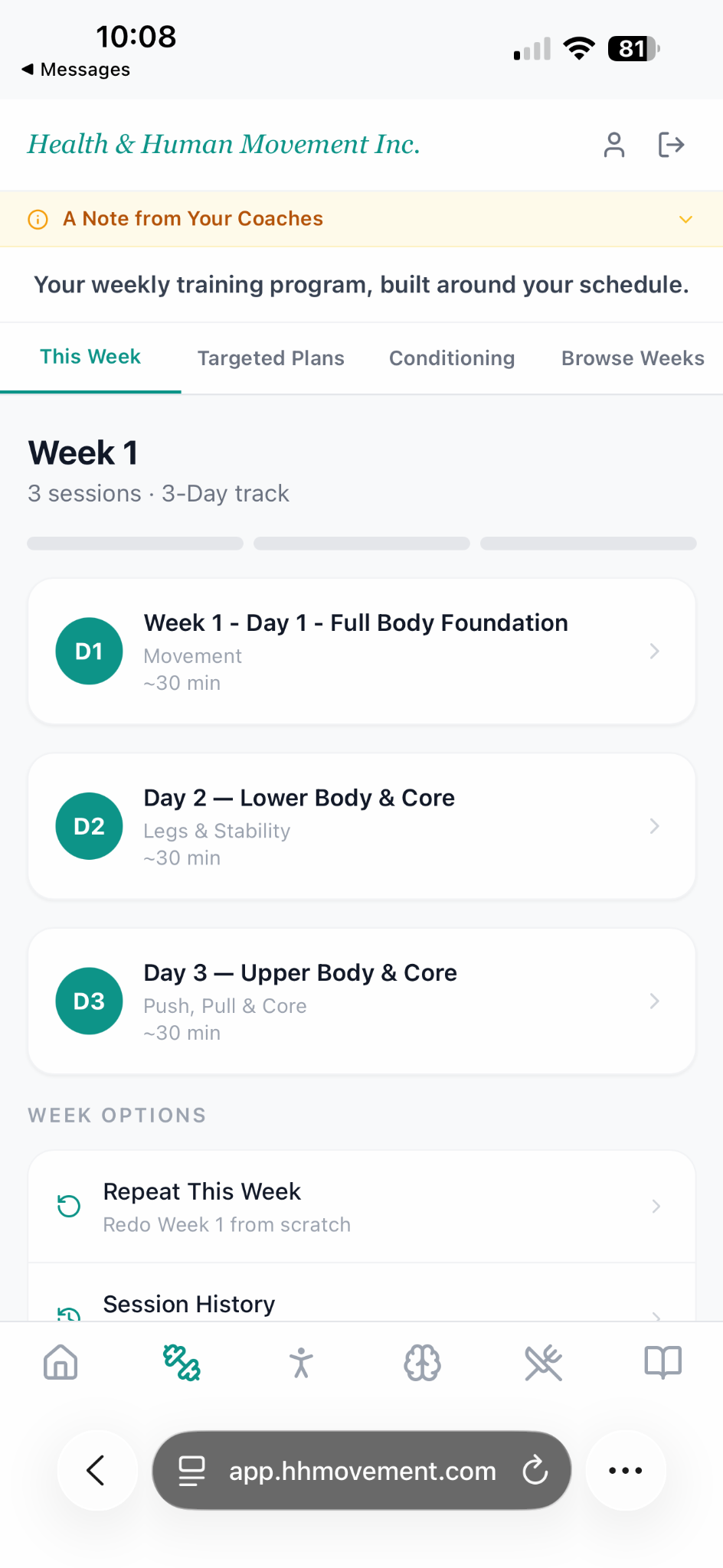
Corporate wellness works when it fits the people and the workplace. A one-time step challenge may create a burst of attention, but lasting value usually comes from a repeatable system: accessible movement, practical education, supportive workplace norms and regular feedback.
What a strong corporate wellness program includes
The best employee wellness program is not necessarily the one with the most features. It is the one employees understand, can access and can return to consistently. For most organizations, that means addressing more than exercise alone.
Fitness for different starting points
Short strength sessions, low-impact movement, walking, conditioning and beginner-friendly options help more employees find an appropriate entry point.
Mobility and recovery
Desk mobility, warmups, cooldowns and recovery routines address stiffness and help employees connect movement with how their bodies feel.
Nutrition and hydration education
Practical guidance can focus on balanced meals, protein, hydration, energy and recovery without promoting restrictive diets or personal medical advice.
Stress and mental performance
Breathing, awareness, reflection and behavior-change tools can support focus and consistency while complementing—not replacing—professional mental healthcare.
Ergonomics and movement breaks
Workstation education and frequent changes in position help address the reality that many office and remote employees sit for long periods.
Organizational support
Leadership participation, protected time, inclusive communication and policies that support healthy choices make individual resources easier to use.
Why an app or digital hub can help
Employees rarely share the same schedule, location, fitness level or goals. A digital wellness hub can make resources available when people need them rather than requiring attendance at one class or access to one facility.
Everyone’s an Athlete is built around the idea that an athlete is anyone working to become more capable and confident in human movement. In a workplace setting, that can translate into guided training, body care, nutrition and mental-performance resources that support different starting points.
A practical corporate wellness framework
The CDC Workplace Health Model organizes program development into assessment, planning, implementation and evaluation. That sequence is a useful guardrail for companies of almost any size.
1. Assess the workplace
Start with employee needs, work demands and current resources. A short anonymous survey can identify preferred formats, scheduling barriers, common interests and whether people work on-site, remotely, in the field or across shifts.
- Ask what employees would use—not what leadership assumes they need.
- Review existing benefits, wellness resources and safety programs.
- Identify barriers such as time, equipment, language, schedule and accessibility.
- Separate population-level planning from individual medical information.
2. Choose a small number of goals
“Improve employee wellness” is too broad to guide a program. Choose specific initial goals, such as increasing access to short movement sessions, improving awareness of recovery resources or helping remote employees take more regular movement breaks.
3. Build an inclusive program
Offer multiple ways to participate. Fitness content should include easier and harder options, clear safety guidance and activities that do not require expensive equipment. Avoid public weigh-ins, forced disclosure or rewards that punish people with disabilities or health limitations.
4. Make participation easy
A 10-minute session employees can find quickly may deliver more practical value than a sophisticated resource buried in a benefits portal. Give the program a clear home, repeat the communication and show people exactly how to begin.
5. Evaluate and improve
Track whether people can access the program, return to it and find it useful. Use feedback to simplify what is confusing, retire what is not used and build on the activities employees value.
Example 90-day corporate wellness pilot
A pilot creates enough time to test the program without pretending the first version will be perfect.
Listen and establish a baseline
Survey employee interests, identify access needs, define two or three goals and document how participation will be measured.
Launch simply
Introduce the program with a short orientation, a beginner pathway and one clear place to find workouts and wellness resources.
Build a repeatable rhythm
Offer a weekly movement focus, one body-care session, one practical wellness lesson and optional team participation.
Learn and refine
Review participation patterns, collect anonymous feedback and decide what should continue, change or stop.
Options for office, remote and active workforces
Office and desk-based teams
Prioritize short movement breaks, workstation education, neck and shoulder mobility, hip movement, walking and strength sessions that can be completed before or after work. OSHA notes that even a good seated posture should not remain static all day and recommends changing position regularly.
Remote and hybrid employees
Create equal access regardless of location. On-demand sessions, minimal-equipment workouts and asynchronous challenges are often more inclusive than programming built around the headquarters gym.
Healthcare, hospitality, manufacturing and field teams
Employees with physically demanding jobs may not need more generic activity. Their program may place greater emphasis on recovery, movement quality, sleep, hydration and job-specific safety coordination. Occupational activity and recreational exercise should not be treated as interchangeable.
Schools, teams and public-service organizations
Programming can be adapted around shift schedules, seasonal demands, shared facilities and the different needs of staff, coaches, students or first responders.
Make participation inclusive—not performative
Wellness programs can lose trust when they feel compulsory, intrusive or designed only for already-active employees. A more inclusive approach:
- Uses opt-in participation and protects privacy
- Provides beginner, low-impact and equipment-free options
- Avoids weight-loss contests and public health rankings
- Uses plain language instead of fitness jargon
- Supports employees with different abilities and health circumstances
- Makes clear that educational content is not individualized medical care
How to measure corporate wellness without overclaiming
Do not promise that a short program will automatically reduce healthcare spending or transform productivity. Measure what the program can reasonably influence first.
Reach
- How many eligible employees heard about the program?
- How many activated access or attended an orientation?
Engagement
- How many employees returned after the first interaction?
- Which sessions or resources were used repeatedly?
Experience
- Did employees find the program useful and easy to navigate?
- Did people feel the options respected their ability level and schedule?
Program improvement
- Which communication channels worked?
- What prevented participation?
- What should be simplified or added in the next cycle?
Questions to ask a corporate wellness provider
- How is the program adapted for different ability levels?
- Can remote, hybrid and shift employees participate equally?
- What equipment or space is required?
- How is employee privacy protected?
- What implementation support is included?
- Which engagement data are available to the employer?
- Does the content include clear medical and safety boundaries?
- How often is the program reviewed and updated?
- What happens after the initial challenge or pilot?
Corporate wellness in San Diego
Looking for a locally focused program? See our guide to corporate wellness and employee fitness in San Diego, including ideas for the region’s office, biotech, healthcare, defense, hospitality and distributed teams.
Common questions
What should a corporate wellness program include?
A useful program can combine movement, strength, mobility, recovery, nutrition education, stress-management skills, ergonomics and organizational support. The right mix depends on employee needs, work demands, company size and available resources.
How do you make employees participate in workplace wellness?
Participation improves when activities are convenient, inclusive, clearly communicated and supported by leadership. Offer short options at different ability levels, protect employee privacy and ask employees what would actually help them.
Can corporate fitness work for remote and hybrid teams?
Yes. On-demand workouts, live virtual sessions, mobility breaks, educational resources and team challenges can reach employees across locations and schedules. Avoid making participation depend on access to a gym or being in one office.
How should employers measure a wellness program?
Start with practical measures such as enrollment, repeat participation, completion, employee feedback and awareness. Depending on the program, employers can also evaluate changes in confidence, habits and perceived usefulness while protecting individual health information.
Is corporate wellness the same as an employee fitness challenge?
No. A fitness challenge is one possible activity. A complete workplace wellness strategy also considers recovery, nutrition, stress, ergonomics, workplace policies, leadership support and the environment in which employees work.
How long should a workplace wellness pilot run?
A pilot of eight to twelve weeks is often long enough to test communication, participation and program fit without requiring a large permanent commitment. Establish the goals and evaluation plan before the pilot begins.
Build a program around your actual team
Everyone’s an Athlete brings training, recovery, nutrition and mental performance into one practical philosophy: meet people where they are and help them build skills they can sustain.
Sources and further reading
- CDC: Strategies for Building a Workplace Health Program
- CDC: Physical Activity Resources for Employers
- OSHA: Computer Workstation Positions and Movement
- OSHA: Ergonomics Overview
Last reviewed: August 25, 2026. This page is educational and does not replace medical, legal, benefits or workplace-safety advice.